
Introduction
Choosing the right harness for a large dog is about much more than finding something that looks rugged. A strong dog can put tremendous force through a leash, especially during training, hiking, working activities, or unexpected distractions. That is why tactical dog harnesses with handle have become popular among owners of large breeds, working dogs, and service dogs.
A well-designed tactical harness can provide a secure control point, multiple leash attachment options, durable construction, and room for identification patches or equipment. However, “tactical” does not automatically mean safe or suitable. Materials, stitching, adjustment points, handle construction, weight, and fit all matter.
Current harness comparisons show considerable variation between products. Some models publish hardware load ratings, while others simply use terms such as “heavy duty” without providing measurable specifications.
The goal is therefore not to choose the most tactical-looking vest. It is to choose equipment that matches your dog’s size, body shape, temperament, and intended job.
Why Tactical Dog Harnesses with Handle Are Useful
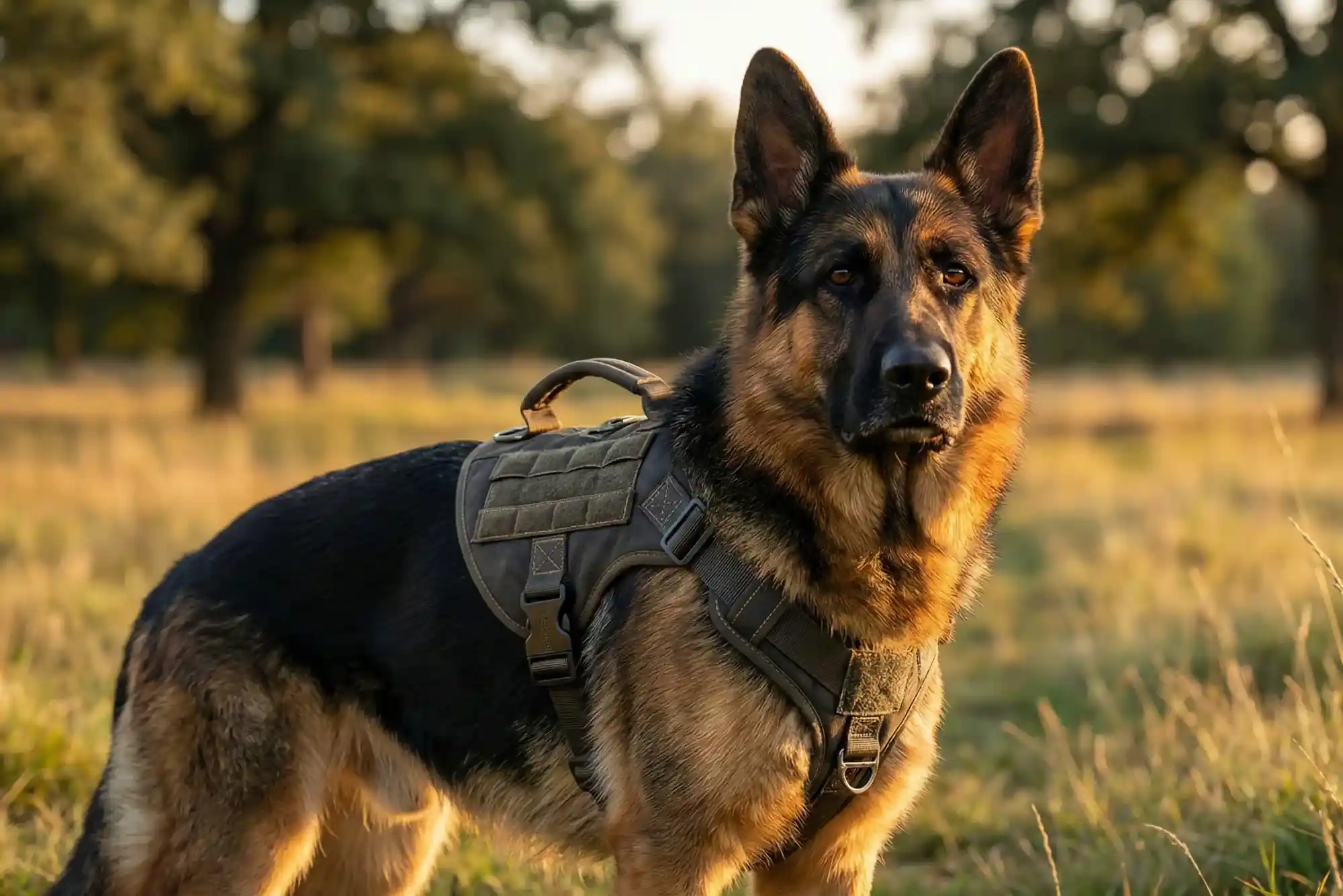
The defining feature of tactical dog harnesses with handle is the reinforced handle positioned on the dog’s back. It gives the handler a quick way to steady, redirect, or briefly control the dog without reaching for the collar.
This can be particularly useful with large breeds such as German Shepherds, Rottweilers, Dobermans, Labradors, and other muscular working dogs. When a dog suddenly changes direction, a top handle can give the handler an immediate grip.

The handle should not be confused with a leash attachment point. A handle is primarily a manual-control feature unless the manufacturer specifically states that it is designed for another purpose.
A useful distinction is especially important for service dogs. A control handle can help with everyday handling, but a standard tactical handle should not automatically be treated as a mobility-support device. Some mobility tasks require specialized harness construction designed for the specific task and the handler’s needs.
What Makes a Good Tactical Dog Harness
A quality tactical dog harness with handle begins with appropriate construction. The outer material needs to tolerate repeated movement, friction, weather, and normal working-dog activity.
Many tactical-style harnesses use heavy nylon fabrics. Current products commonly advertise 1000D or similar heavy-duty nylon, although fabric denier alone does not prove that an entire harness is stronger or safer. Stitching, webbing, buckles, D-rings, and the way these components are connected are equally important.
The handle deserves particular attention. A decorative loop may look like a grab handle but may not be designed for serious control. Look for a handle that is securely sewn into the harness structure and reinforced at its attachment points.
Hardware is another major consideration. Metal buckles and D-rings can provide a robust feel, but their presence alone does not establish a specific load capacity. One current tactical harness comparison, for example, highlights manufacturers that publish actual hardware ratings while noting that many competing products do not.
For a large dog, published specifications are more useful than marketing language.
How to Choose the Right Harness for a Large Breed
Large dogs do not all have the same body shape. A German Shepherd can have a very different chest and shoulder structure from a Labrador, Mastiff, or Rottweiler.
That makes measurement more important than breed labels.
Measure the dog’s chest girth around the deepest part of the rib cage, following the manufacturer’s instructions. Do not select a size simply because the package says “Large.” Current service-harness research specifically recommends matching the dog’s measured girth to a manufacturer’s numerical sizing chart.
The harness should feel secure without squeezing the chest. You should also check the area behind the front legs. Excessive rubbing there can quickly become uncomfortable, especially when the dog wears the harness for extended periods.
A good fit should allow normal walking, sitting, turning, and running. If the harness shifts dramatically from side to side, it may be too loose or poorly shaped for your dog’s body.
Important Features for Service Dogs
Service dogs have different requirements depending on their training and tasks. Some handlers primarily need identification and everyday control. Others may need equipment compatible with specific working tasks.
For general handling, tactical dog harnesses with handle can provide useful control and a stable platform for identification patches. Hook-and-loop panels are common on tactical-style vests, allowing handlers to attach removable labels.
However, a patch itself does not create service-animal rights or public-access status. The harness is equipment; the dog’s legal status depends on the applicable laws and regulations.
A current service-harness comparison notes that no special harness is required simply because a dog is a service dog. Instead, handlers may select equipment based on practical requirements such as identification, guide control, or mobility-related features.
If the dog performs physical assistance tasks, choose equipment specifically designed for those tasks rather than assuming that a tactical vest is automatically suitable.
Tactical Harnesses for Control and Training
A major advantage of tactical dog harnesses with handle is versatility.
Many models provide more than one leash attachment location. A rear attachment can work well for regular walking, while a front attachment can be useful during certain training approaches.
The important point is that equipment does not replace training.
A strong harness can help a handler manage a large dog, but it cannot teach loose-leash walking, reliable recalls, impulse control, or public-access behavior. For service dogs especially, training remains the foundation.
The handle can be particularly helpful when moving through crowded areas, entering vehicles, navigating narrow spaces, or briefly redirecting the dog. It should be used calmly rather than as a substitute for leash handling.
MOLLE Panels and Tactical Accessories
MOLLE-style webbing is one of the features that makes tactical harnesses visually distinctive. It can allow compatible pouches or accessories to be attached to the vest.
For working dogs, this can be useful when the handler needs to carry lightweight items. However, more attachment space is not automatically better.
Additional equipment adds weight. A heavily loaded harness can become uncomfortable and may change how a dog moves. Accessories should therefore be limited to what the dog genuinely needs.
The same principle applies to large patches and bulky attachments. A working harness should remain functional rather than becoming unnecessarily heavy.
Comparing Popular Tactical Harness Designs
Different harness designs suit different jobs.
The Ruffwear Web Master, for example, uses a padded lift handle and offers multiple adjustment and leash points. Its published girth range extends across several sizes, making it adaptable to different body shapes.
The Julius-K9 IDC Guide Dog Harness takes a different approach. Its published specifications include replaceable identification labels, while a guide handle is available separately. This illustrates an important point when comparing harnesses: not every handle shown or discussed in product ecosystems is necessarily included with the basic harness.
Ray Allen’s working-dog harnesses also demonstrate how specialized designs can differ. Its Opportunity Harness includes a large sewn support handle, while its Ultimate Harness uses two cushioned handles and additional attachment features.
OneTigris products represent another side of the tactical market. Current comparisons highlight heavy nylon construction, metal hardware, grab handles, and MOLLE-style features. Some models publish specific hardware load ratings, which makes their specifications easier to evaluate than products that provide only general “heavy duty” claims.
These differences show why choosing by appearance alone is risky. The appropriate harness depends on the dog’s measurements and the work it needs to perform.
Handle Strength Matters More Than Appearance
A handle is one of the most frequently misunderstood features on a tactical harness.
A thick-looking handle does not necessarily mean it can support a particular amount of force. The strength of the complete system depends on the webbing, stitching, reinforcement, harness body, and connection points.
For this reason, never assume that a tactical handle can safely support a dog’s full body weight unless the manufacturer specifically states that the harness is designed for that purpose.
Some manufacturers publish load ratings for hardware. Others do not. When a rating is unavailable, it is safer to treat the handle as a control and stabilization point rather than a lifting device.
This distinction becomes particularly important with large dogs.
Comfort and Breathability Should Not Be Ignored
Durability is valuable, but a harness can be extremely strong and still be a poor choice if your dog cannot comfortably wear it.
Large tactical vests can be heavier than ordinary walking harnesses. Thick materials may also retain more heat, particularly in warm weather.
Look for breathable lining or mesh where appropriate, especially if the dog will wear the harness during outdoor activities.
You should also inspect areas around the neck, chest, shoulders, and front legs after the first few uses. Redness, hair loss, repeated scratching, or reluctance to move can indicate a fit or comfort problem.
A harness should support the dog’s work rather than interfere with it.
Common Mistakes When Buying a Tactical Dog Harness
One of the biggest mistakes is choosing a harness based entirely on weight ratings or the phrase “military grade.” Marketing terminology varies widely between manufacturers.
Another common mistake is selecting a size based on breed rather than measurement. Even dogs of the same breed can have very different proportions.
Buying a harness with too many features can also be counterproductive. If your dog only needs a leash attachment and control handle, a heavily loaded MOLLE vest may provide unnecessary bulk.
Finally, avoid assuming that every handle is designed for lifting. Unless the manufacturer explicitly describes the harness as suitable for lifting or mobility assistance, use the handle primarily for short-duration control.
How to Maintain a Tactical Dog Harness
Regular inspection can extend the useful life of a harness and help identify problems before they become serious.
Check the stitching around the handle and leash attachment points. Inspect the webbing for fraying and examine buckles for cracks or deformation. D-rings should remain firmly attached and should not show significant bending or damage.
Clean the harness according to the manufacturer’s instructions. Dirt, sand, mud, and moisture can gradually affect fabrics and hardware.
After intensive outdoor use, allow the harness to dry completely before storing it. If your dog frequently works in wet or muddy environments, more frequent inspections are worthwhile.
When Should You Replace a Tactical Dog Harness?
Replacement should depend on condition rather than age alone.
If stitching begins separating, webbing becomes badly frayed, a buckle cracks, or a leash attachment point becomes distorted, the harness should be removed from service.
This is especially important for large dogs because their strength can turn a small equipment failure into an escape or injury risk.
Do not wait until the harness completely fails. A visible structural problem is enough reason to replace it.
FAQs
What is the best tactical dog harness for a large dog?
The right tactical dog harness depends on your dog’s measurements and intended use rather than one universal model. Large-breed handlers should prioritize accurate girth sizing, secure construction, reinforced handles, suitable leash attachment points, and comfortable movement. Current comparisons include models from Ruffwear, Julius-K9, Ray Allen, OneTigris, and other manufacturers with different designs and specifications.
Are tactical dog harnesses good for large dogs?
They can be useful for large dogs when correctly fitted and appropriate for the activity. A tactical design can provide a control handle, durable materials, multiple attachment points, and accessory space. However, heavier construction can also add weight and heat, so the dog’s comfort and intended use should determine the choice.
Can you lift a dog with a tactical harness handle?
Not necessarily. A grab handle is generally intended for short-duration control unless the manufacturer specifically states that the harness is designed for lifting or mobility assistance. Never assume that a handle can safely support a large dog’s full body weight.
Do service dogs need a special harness?
A service dog does not automatically need a particular style of harness. Equipment is generally selected according to practical needs such as identification, control, or a specific trained task. A current service-harness comparison also notes that a special harness is not required simply because a dog is a service dog.
What size tactical harness does a German Shepherd need?
There is no universal German Shepherd harness size. Measure the dog’s chest girth and compare that measurement with the manufacturer’s size chart. Weight and breed can help as general references, but girth is a much more reliable starting point.
Are tactical dog harnesses good for service dogs?
They can be suitable when their design matches the dog’s working requirements. A service dog that only needs identification and everyday control may use a different harness from one performing specialized mobility tasks. The key is choosing equipment for the dog’s actual job rather than buying a tactical vest simply because it looks professional.
What should I look for in a tactical dog harness?
Look for an accurate size range, secure adjustment points, comfortable chest coverage, durable webbing, reliable buckles, reinforced leash attachment points, and a properly constructed handle. If the harness will carry accessories, make sure those additions do not create excessive weight or interfere with movement.
The best tactical dog harnesses with handle are not necessarily the biggest, heaviest, or most heavily accessorized. The right harness is the one that fits securely, gives the handler appropriate control, supports the dog’s working needs, and remains comfortable during real-world use.
For large breeds, pay close attention to chest measurements, handle construction, stitching, hardware, and weight. For service dogs, consider the dog’s actual tasks and avoid confusing a tactical appearance with specialized mobility equipment.
Before buying, measure your dog carefully and read the manufacturer’s specifications instead of relying on generic “heavy duty” claims. A well-fitted harness can become a valuable part of everyday handling, training, outdoor activities, and working-dog equipment.