Introduction
If your dog turns into a barking, lunging, pulling mess whenever another dog appears on a walk, you are dealing with a common but frustrating training problem. Learning how to stop a dog from barking at other dogs on leash is not simply about teaching the word “quiet.” The behavior usually has an emotional cause, such as fear, frustration, excitement, or feeling trapped by the leash.
Leash reactivity can look dramatic, but barking does not automatically mean that a dog wants to attack. Some dogs bark because they want to greet another dog and cannot reach it. Others bark because they want the approaching dog to move away. The American Kennel Club notes that leash restraint can contribute to frustration and reactive behavior because dogs cannot freely approach or retreat.
The most effective approach is usually management combined with gradual desensitization and counterconditioning. Your goal is not merely to suppress the bark. You want your dog to notice another dog without becoming overwhelmed.
Why Does My Dog Bark at Other Dogs on Leash?
Before changing the behavior, identify what may be driving it. Barking is communication, and the same outward behavior can have different causes.
Fear or insecurity
A nervous dog may bark to make another dog increase its distance. You may notice a stiff body, tucked tail, pinned ears, backing away, or intense staring before the barking begins.
For these dogs, getting closer to the trigger can make the problem worse. A fearful dog needs enough space to feel safe and learn that another dog does not automatically predict danger.

Frustration and the desire to greet
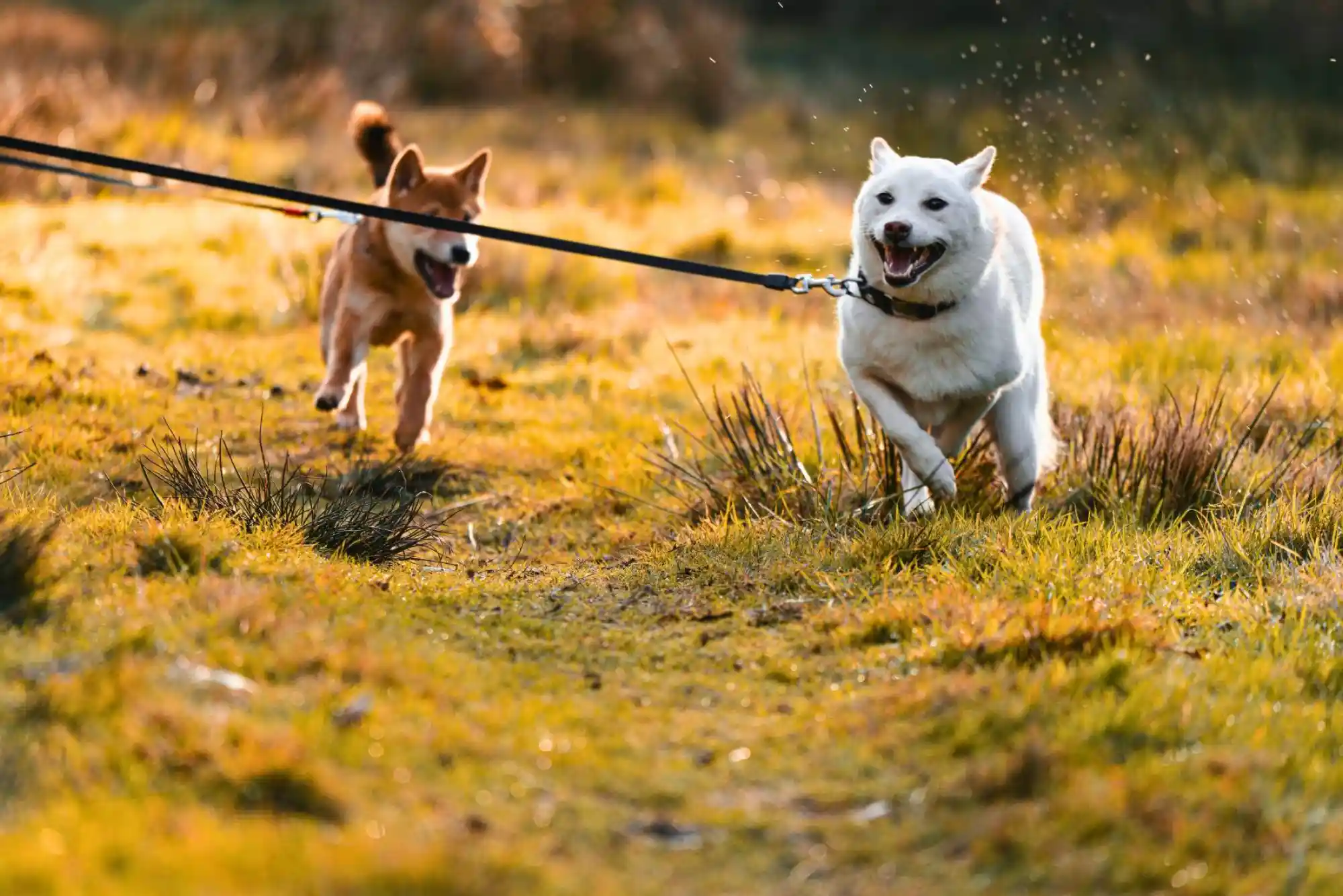
Some dogs are extremely social. They may pull forward, whine, wag their tail, and bark because they desperately want to reach the other dog.
This is often called leash frustration. The leash prevents the dog from performing the behavior it wants, so excitement can spill over into barking and lunging.
Over-arousal
Some dogs simply become too excited when they see movement, especially another running or energetic dog. Once arousal becomes high enough, listening to the handler becomes difficult.
This is why repeatedly saying “sit” or “quiet” while your dog is already exploding at another dog usually produces limited results. The training needs to happen before your dog reaches that state.
What Is Leash Reactivity?
Leash reactivity describes an exaggerated response to a trigger while a dog is restrained. Barking, lunging, growling, whining, pulling, and staring can all be part of the picture. Best Friends Animal Society describes leash reactivity as a relatively common behavior that can be directed toward dogs, people, animals, bicycles, cars, and other triggers.
Importantly, leash reactivity is not automatically the same thing as aggression. A reactive dog may be frightened, frustrated, or overexcited without intending to harm another dog. The underlying motivation matters when designing a training plan.
That distinction is useful because it changes how you approach the problem. Instead of asking, “How do I punish my dog for barking?” ask, “What does my dog need in order to remain calm enough to learn?”
The Most Important Concept: Find Your Dog’s Threshold
If you remember only one part of this reactivity protocol, remember this: distance is a training tool.
Your dog has a threshold. This is the point at which seeing another dog becomes so intense that your dog can no longer respond normally.
Below threshold, your dog might notice another dog, look at you, eat a treat, and continue walking.
Over threshold, your dog may stare, freeze, bark, pull, lunge, ignore food, or stop responding to familiar cues.
The American Kennel Club recommends working at a distance where the dog can notice the trigger without reacting, then pairing the trigger with valuable rewards.
Your starting distance might be 20 feet, 50 feet, or even farther. There is no universal number because every dog and environment is different.
How to know you are far enough away
Watch your dog’s body rather than focusing only on barking.
If your dog can look at another dog and then turn back toward you, you probably have a workable training distance. If your dog cannot eat, cannot respond to their name, or is staring intensely, increase the distance.
Training at a distance is not “avoiding the problem.” It is creating conditions in which your dog can actually learn.
How to Stop a Dog from Barking at Other Dogs on Leash
Once you understand your dog’s threshold, you can begin a structured reactivity protocol.
Start with management
For the first stage, prevent unnecessary rehearsals of the barking behavior.
Choose quieter walking routes and times when fewer dogs are likely to appear. Cross the street when necessary. Use parked cars, driveways, hedges, or other visual barriers when they help create space.
The American Veterinary Society of Animal Behavior recommends management alongside behavior modification for fearful or reactive dogs because repeated overwhelming encounters can interfere with training.
Management is not the complete solution, but it protects the progress you are trying to make.
Teach an attention cue away from dogs
Before practicing around triggers, teach your dog to respond to a simple cue such as their name or “look.”
Practice inside your home first. Say the cue once, and when your dog looks toward you, reward immediately.
Then practice in the yard or another low-distraction environment.
You want the response to become automatic before you need it during a difficult walk.
Introduce the trigger at a safe distance
Now find an environment where you can see other dogs without being forced into close encounters.
The moment your dog notices another dog, calmly mark the behavior with a word such as “yes” and deliver a high-value reward.
Chicken, cheese, a favorite treat, or another reward your dog genuinely values can work well.
The important timing is this:
Dog appears → dog notices → reward.
You are teaching your dog that seeing another dog predicts something positive.
Reward disengagement
Do not wait for your dog to stare at the other dog for several seconds.
Reward the moment your dog looks away, checks in with you, or relaxes their body.
Over repeated sessions, the dog can begin to learn that noticing another dog does not require a barking response.
This is closely related to desensitization and counterconditioning, approaches recommended for changing emotional responses to triggers.
What If Your Dog Starts Barking?
Even with careful training, your dog will sometimes react. Do not treat a setback as failure.
Your first priority is to create distance.
Turn and walk away if necessary. Use a parked car or another visual barrier. Keep your movements controlled and avoid dragging your dog directly toward the trigger.
Once your dog is calm again, you can continue the walk or end the training session.
The mistake is staying close and repeatedly asking for obedience while your dog is already overwhelmed. That situation provides little opportunity for successful learning.
Why Punishment Can Make Reactivity Harder
It can be tempting to jerk the leash, shout “no,” or use corrections when your dog barks at another dog.
However, punishment can add unpleasantness to an already difficult situation. If your dog is frightened, another correction may make the presence of other dogs even more stressful.
Reward-based training instead gives the dog a clear alternative behavior and changes the association with the trigger. The AKC recommends positive reinforcement and gradual exposure when addressing leash lunging and discomfort around other dogs.
This does not mean allowing your dog to behave without boundaries. It means teaching those boundaries through a strategy your dog can understand.
Build a Reliable Emergency U-Turn
One of the most useful skills for reactive dogs is a practiced U-turn.
Choose a phrase such as “this way.” Say it happily, turn around, and encourage your dog to follow you. Reward them for coming with you.
Practice this when no dogs are present.
Later, when an unexpected dog appears too close, you have a rehearsed way to leave instead of standing there trying to control an escalating reaction.
Teaching your dog to move away from approaching dogs can also help reduce unwanted interactions during walks.
Progress Slowly Instead of Forcing Close Encounters
A common mistake is reducing distance too quickly.
Suppose your dog can remain calm when another dog is 40 feet away. That does not mean you should immediately move to 20 feet.
Make smaller changes and watch your dog’s body language. If the dog becomes tense or starts reacting, increase distance again.
The American Veterinary Society of Animal Behavior emphasizes that desensitization and counterconditioning are not instant fixes and should proceed at the animal’s pace.
Progress can look surprisingly small. A dog that previously barked immediately might eventually look at another dog, glance back at the owner, and continue walking. That is meaningful improvement.
Create Better Walks, Not Just Quieter Walks
A reactive dog still needs enrichment, exercise, sniffing opportunities, and normal canine activities.
If every walk becomes a stressful obedience session, your dog may become more frustrated.
Give your dog opportunities to sniff in safe areas. Use food puzzles at home. Practice simple training games. Choose routes where your dog has room to move.
A calmer overall dog may have more emotional capacity to handle triggers during structured training.
When You Should Work With a Professional
Professional help is particularly important if your dog has attempted to bite, has caused an injury, has redirected onto you, or becomes impossible to control physically.
A veterinarian can also help determine whether pain or another medical issue could be contributing to a sudden behavior change.
For serious cases, look for a qualified reward-based trainer or a veterinary behavior professional who has experience with canine reactivity.
If your dog has a bite history, safety management should come before close-contact training. Behavior modification should be designed around preventing another incident rather than testing how close your dog can get to a trigger.
How Long Does Leash Reactivity Training Take?
There is no reliable universal timeline.
Some dogs show noticeable changes after consistent practice, while others require months of carefully managed training. Your dog’s history, temperament, trigger distance, environment, previous experiences, and consistency all influence progress.
Avoid programs that promise a guaranteed cure in a few days.
The goal is steady improvement: fewer explosive reactions, faster recovery, greater ability to respond to you, and increased comfort around other dogs.
Common Mistakes That Slow Progress
One of the biggest mistakes is repeatedly allowing your dog to explode at close range and hoping they will eventually “get used to it.” Repeated exposure does not automatically create calm behavior. Some dogs can actually become more sensitive to triggers through repeated overwhelming experiences.
Another common mistake is relying entirely on treats after the dog has already entered a full reaction. Food works best when the dog is still capable of learning.
Finally, do not measure success only by whether your dog stays silent. A dog that notices another dog, remains loose, and chooses to look back at you is showing a much more useful behavioral change than a dog that is physically restrained but still intensely staring.
Make Calm Behavior the New Habit
Learning how to stop a dog from barking at other dogs on leash starts with understanding why the reaction happens. Fear, frustration, excitement, and restraint can all produce similar-looking barking, but the training solution begins in the same place: keep the dog below threshold, create distance, reward calm observation, and gradually build tolerance.
Do not rush the process. Protect your dog’s training by managing difficult encounters, practice short sessions, and celebrate small improvements.
FAQs
How do I stop my dog from barking at other dogs while walking?
Start by increasing the distance between your dog and the other dog. Work at a distance where your dog can notice the trigger without barking, then reward calm behavior and attention toward you. Gradually reduce the distance only when your dog can remain relaxed.
Why does my dog bark at other dogs but not people?
Dogs can develop specific triggers. Your dog may be fearful of other dogs, frustrated because they want to greet them, or highly excited by canine movement. Leash restraint can intensify these emotions because the dog cannot freely approach or retreat.
Should I let my dog greet other dogs on leash?
Not necessarily. On-leash greetings can increase frustration or create uncomfortable interactions, particularly for reactive dogs. Teaching your dog that passing another dog calmly is normal can be more useful than expecting every encounter to become a greeting.
How do I socialize my dog that barks at other dogs?
Socialization does not mean forcing your dog into close contact with other dogs. Instead, provide controlled exposure at a comfortable distance and reward calm behavior. Gradual exposure is more appropriate than overwhelming a fearful or reactive dog.
Is leash reactivity the same as aggression?
No. Leash reactivity refers to an exaggerated emotional response, which may involve barking, lunging, growling, or pulling. Aggression involves different behavioral motivations and cannot be diagnosed simply from barking on a leash.
Should I punish my dog for barking at other dogs?
Punishment is generally not the foundation of a behavior-modification plan for leash reactivity. Instead, focus on preventing overwhelming encounters and rewarding calm alternative behaviors. Desensitization and counterconditioning are commonly recommended approaches.
What should I do if another dog suddenly gets too close?
Create distance as quickly and safely as possible. Use your practiced U-turn, cross the street, or move behind a visual barrier. The goal is to prevent the situation from escalating rather than forcing your dog to remain close to the trigger.